
Quinan River (Blueberry Hummocks)
29 Sep 2026
Lichen-likers rejoice: we are proud to announce that our most recently protected property is a safe haven for an astonishing twenty-nine species of lichens!

The newly protected property, South Quinan (Blueberry Hummocks).
The Quinan River (Blueberry Hummocks) property encompasses 112 acres (45 hectares) in South Quinan, Yarmouth County. It sits within Kespukwitk, one of the seven traditional Mi’kmaw districts, which is renowned as an important biodiversity hotspot and formally recognized federally and provincially as a Priority Place for Species at Risk.
The Nature Trust works across Kespukwitk to conserve important habitats and landscapes; this newly protected land falls within our Tusket River Watershed Focus Area, which supports some of the highest global concentrations of at-risk Atlantic Coastal Plain Flora (ACPF) species. Indeed, two ACPF species, Round-leaved Greenbrier and Highbush Blueberry, were documented on the land during a recent site visit, and it holds suitable habitat for the establishment of other highly at-risk ACPF that have been documented nearby.
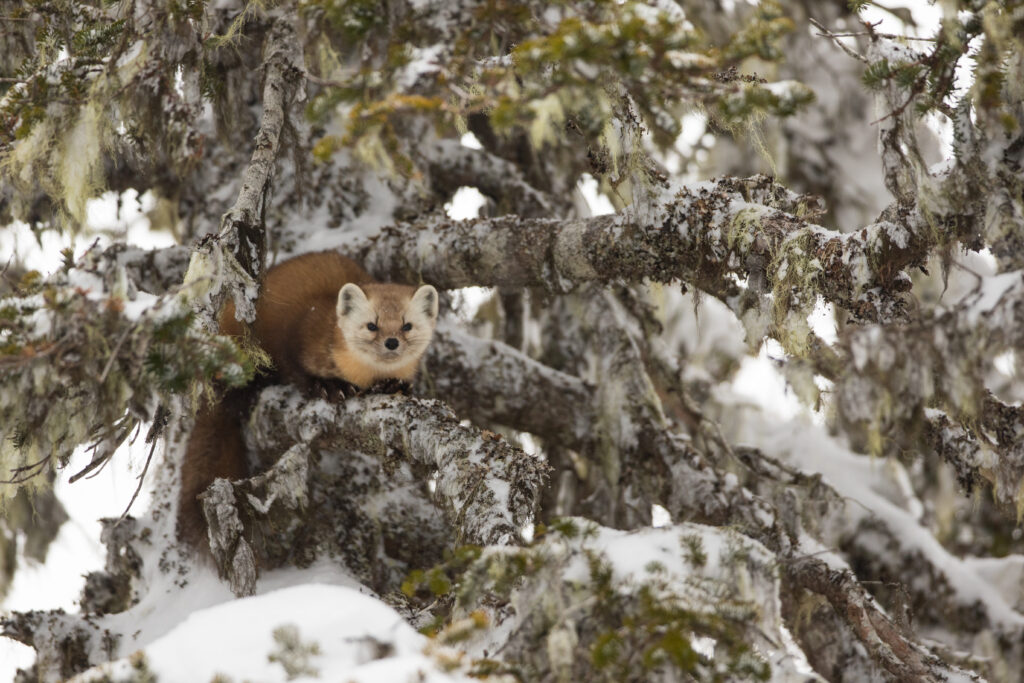
The survey also revealed two other rare vascular plants: Eastern Blue-Eyed-Grass and Yellow Bartonia. Although not directly observed, the property lies within core habitat for both Mainland Moose and American Marten.


But let’s get to the star of this show: the LICHENS. Sometimes unassuming, sometimes wildly outrageous, lichens are neither plant nor animal. They are unique composite organisms made from a partnership between a fungus and a photosynthetic partner like algae or cyanobacteria. They can grow almost anywhere and get everything they need to survive from the air, giving them special powers to help monitor air quality and pollution levels. They are a keystone species in many ecosystems, providing food and nesting materials for many animals while cycling critical nutrients like nitrogen into the soil to help nourish other life.
Many lichens grow on mature trees and require intact forests in order to thrive. This newly protected land is mostly forested, including wet mixedwood and hardwood forests stands that provide excellent habitat for lichens. The wet mixedwood stands are dominated by Red Maple, some of which occur in swampy areas. The Red Maple provide a suitable substrate for lichen to grow on, and the swamp provides high levels of humidity which is also necessary for the survival of many lichen species. There are several very large Red Oak and White Ash trees, which are interspersed within the mature forest stands. Protecting this forest helps conserve the trees, habitat structure and ecological conditions that support a diverse lichen community.

Wrinkled Loop Lichen (Hypotrachyna livida). Photo: Jason Hollinger, CC BY 2.0 via Wikimedia Commons
During the site visit, a total of 29 species of lichen were recorded, including Powdered Ruffle Lichen and Appressed Jellyskin Lichen. During the same survey, the team also discovered Wrinkled Loop Lichen (Hypotrachyna livida) on the neighbouring parcel of land, only a few hundred meters from the property line. This observation is notable as the first record for Canada of this species!
This thrilling observation underscores the importance of protecting connected habitats, as future surveys may well reveal additional instances of Wrinkled Loop Lichen and other nearby rare species on the protected land itself. This new property extends the growing network of protected areas in the region; within 10 kilometers to the north are six Nature Trust conservation lands as well as the Tusket River Wilderness Area, Tusket River Nature Reserve, and the Nature Conservancy of Canada’s Tusket River Atlantic Coastal Plain Flora Conservation Lands. The conservation of this property extends this network toward the south, creating a closer link to the Great Barren and Quinan Lakes Nature Reserve.
 This project was made possible by the Waltons Trust.
 Saving Nova Scotia’s most incredible wild nature depends on the ongoing support of passionate individuals coming together to protect tomorrow, today. Thanks to you, South Quinan (Blueberry Hummocks) and other spectacular and at-risk wild places will remain in our nature, forever. You can support this work with a gift today. A gift of any size makes a real difference.